As a proud owner of a diode laser machine, you might need some inspiration. The choice of materials available to you is somewhat smaller than with CO2 laser cutters. And that limits your options, right?
Diode lasers make laser cutting accessible to everyone because they are more affordable and smaller than CO2 laser cutters. They are therefore an ideal choice for hobbyists and model makers. One drawback of diode lasers is that not all materials can be safely processed in them.
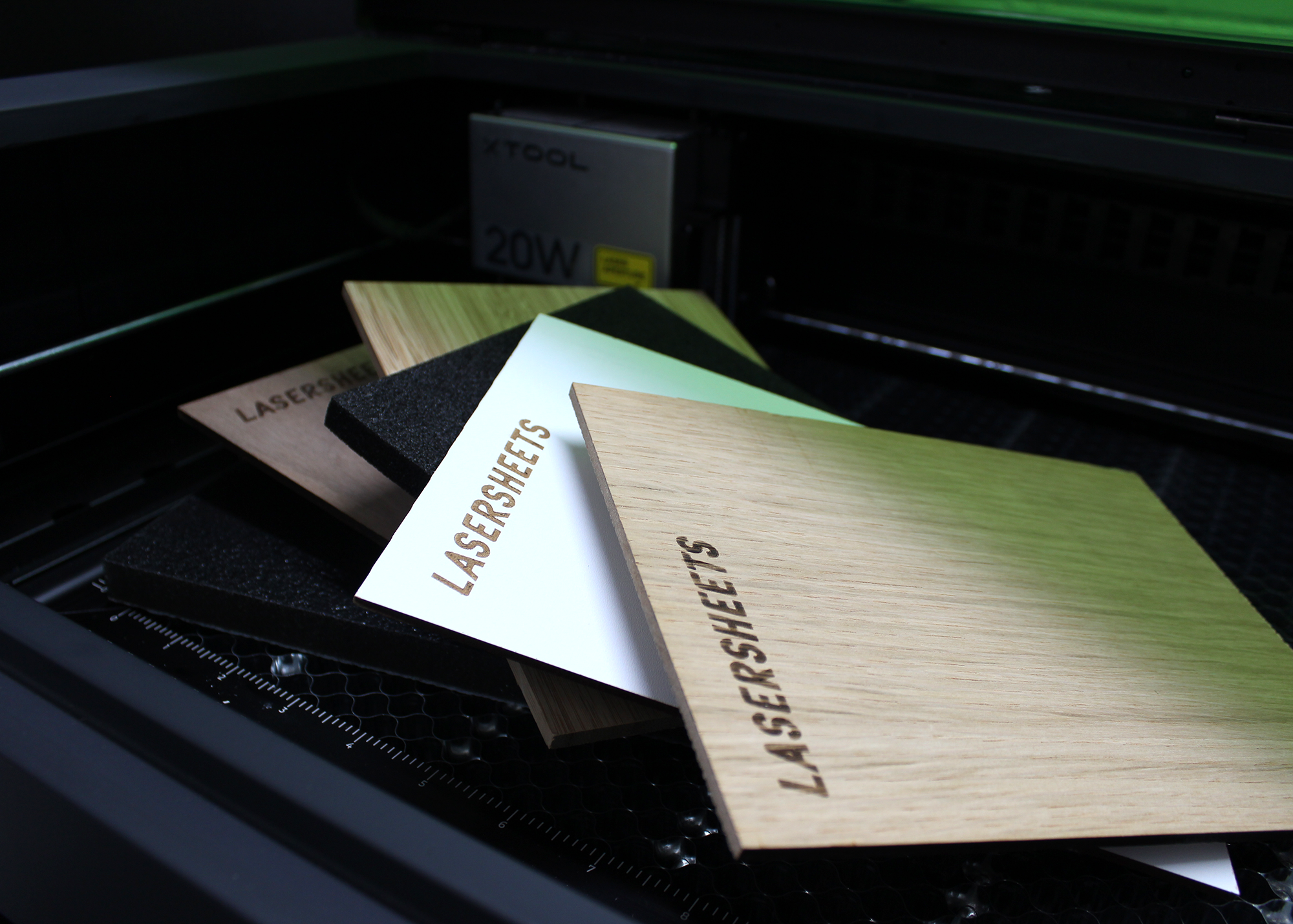
Lasersheets has a large number of customers with diode laser machines. For safety and the best results, it's important that you use the right materials. Our top 10 best materials for diode lasers shows you that, as an owner of this device, you're certainly not always limited.
UPDATE Feb. 2025: Also check out the new Starter Kit: Diode 10W. There you will find an affordable pack with various materials suitable for diode lasers from 10 watts.
The 10 Best Diode Laser Materials
With these materials for your diode laser machine, you can create magnificent objects, such as (small) furniture, jewelry, utensils, and model parts. They all have different characteristics, making them suitable for various projects.
Read on for the top 10 materials ideal for diode laser machines.
1. Birch Plywood

We love birch plywood, and this material absolutely deserves its first-place spot. This wood for diode lasers is strong and hard, known for its beautiful, clearly visible natural grain. Thanks to its cross-bonded layers, it will break less easily than, for example, solid wood.
When choosing birch plywood for your diode laser, pay attention to the following points:
- Is it high quality, like Lasersheets' B/B grade birch plywood?
- Is it knot-free?
- Is the correct glue used that is safe for diode laser cutters?
Birch plywood is highly versatile, suitable for making models, keychains, and lampshades, for example. In its untreated state, it is not suitable for outdoor use.
2. MDF

While plywood is constructed from various thin wood sheets, MDF boards are made from bonded wood fibers. This makes it homogeneous, robust, and stiff, ideal for projects requiring a strong material. It's also a perfect diode laser material because it's very affordable and incredibly versatile.
Here too, it's important to ensure that the MDF is made with laser-friendly glue. We recommend choosing boards with the LaserGrade Diode label. This way, you'll know not only that the correct glue has been used, but also that it can be processed smoothly with a diode laser.
What do our Xtool users make with MDF? This can be anything from sectional models to furniture and 3D sculptures. Bare MDF still needs to be finished and cannot be used outdoors.
Tip: also check out our MDF 1mm sheets, for an extra thin and versatile diode laser material.
3. PE Rigid Foam

It might surprise you that PE rigid foam can be used in a diode laser machine. Rubber and plastic often melt and smoke in diode lasers, making them unsuitable and even unsafe. Our PE rigid foam has the LaserGrade Diode label and is completely safe in diode lasers. And our customers are very happy to take advantage of that.
PE rigid foam is waterproof, floats, and is highly resistant to chemicals. It is also soft (compare it to a slightly firmer mattress) and flexible.
This allows you to create original items, such as company logos and packaging. It's also widely used as an inlay for cases or tool drawers. It can be applied outdoors without issues, making it an interesting choice for signage as well.
4. Black MDF

Standard MDF is unfinished, but black MDF is dyed black throughout. This makes it slightly more expensive than standard MDF, but you don't need to paint it. This diode laser material remains black, even along the cut edges.
Black MDF has the same characteristics as standard MDF, making it affordable, homogeneous, and even stronger. It is, however, slightly heavier than standard MDF. Finishing is not necessary, but optional.
With black MDF, you can use your Glowforge Aura to create enclosures, technical prototypes, or signage, among other things.
Tip: our white coated MDF is also popular among diode laser owners and, with its decorative top and bottom layers, is ideal for use in furniture and displays. You can create a unique image when you engrave it. It is not dyed through and through like black MDF.
5. Bamboo

Bamboo is also an excellent wood type for diode lasers. It has a natural appearance, and because bamboo grows quickly, it's also a sustainable choice. Our sheets consist of glued bamboo strips, with a hard and smooth surface.
Bamboo is a material you truly choose for its natural aesthetic. It is important to remember that it is somewhat less strong along the grain. Other than that, it is a stiff and tough Xtool material that can also be perfectly used in a diode laser machine.
Our diode laser customers love bamboo, but it's not as broadly applicable as, for example, birch plywood. What can you make with it? Think of beautiful front panels (for your kitchen cabinets?), jewelry or a lovely brooch, enclosures, or retail displays.
6. Oak MDF Core

With our oak sheet with an MDF core, you kill several birds with one stone. The MDF core makes it strong and affordable, while the oak veneer finish on both sides makes it a very decorative material. Unless you have other ideas, it typically doesn't need any further finishing.
Our diode laser machine customers choose oak sheets with an MDF core when they need a material with a natural and elegant appearance. It's therefore a diode laser material frequently used for items meant to be seen, such as displays, lamps, and furniture.
Tip: use our oak diode laser material with an MDF core as a baseplate for your model or maquette. We also sell walnut MDF core for a darker colored sheet.
7. Laserboard

At Lasersheets, we're big fans of laserboard, and it's excellent news that it can also be used with diode lasers. Laserboard consists of resin-impregnated cardboard pressed into a sheet. This gives it the strong and flexible characteristics for which laserboard is so well known.
Laserboard is an ideal material for diode lasers because it is widely used in model building. Diode lasers like those from Gweike are smaller and therefore better suited for cutting smaller shapes.
With laserboard, you can add the smallest details to your model, such as windows, pebbles, and fences.
8. Closed-cell Neoprene Rubber

Looking for a type of foam rubber for your laser machine? Then closed-cell neoprene rubber is a smart diode laser material to consider. Like PE rigid foam, it has closed cells, making it water-resistant and also insulating.
Our customers therefore use it extensively for sealing and dampening. We sell neoprene in various thicknesses, and the thicker the sheet, the better the thermal insulation and acoustic dampening. Neoprene is flexible, wear-resistant, and can be used for a wide range of unique applications.
9. Poplar Plywood

Poplar plywood is yet another type of wood for diode lasers. It is one of the Xtool materials used for projects where strength is less critical. Compared to birch plywood, poplar plywood is softer, lighter, less stiff, and less strong.
Here too, it's important that you purchase a plywood sheet for your Ortur diode laser that uses the correct glue, contains few knots, and is of high quality. Because it is a soft material, even thicker sheets can be easily cut by your diode laser machine.
Our customers use this diode laser material for model building or art installations, among other things. If you care for and finish it properly, it can also be used outdoors, for example, as a signboard.
10. Double-sided Adhesive Film

When you think of diode laser materials, double-sided adhesive film is probably not an option that comes to mind. Nevertheless, it is a good material to use here, especially since diode laser hobbyists will find it very useful.
Model builders with, for example, a Sculpfun diode laser, apply this film to the material before laser cutting. Then, stick your facade onto the wall of your model or a letter onto a wall. With double-sided adhesive film, you can directly adhere your object to something after it comes out of the diode laser.
Diode Laser Materials Abound
So it's really not true that you can only make simple objects with a diode laser. There is plenty of variation possible with the materials offered. Our customers are very happy to take advantage of this, as you can see from our versatile top 10.
At Lasersheets, it's easy to see which materials are suitable for your diode laser. It's a filter option, for example, but we also have a dedicated page for diode laser materials. Additionally, there's the blue LaserGrade label, which you'll only find on materials that can be used in your Xtool, Sculpfun, Ortur, Gweike, or Glowforge Aura diode laser.
Do you have any more questions about diode laser materials? Do you want to be sure if your diode laser is suitable? We have over 10 years of experience with laser cutting, both with CO2 lasers and diode lasers. Therefore, please contact us, and we'll be happy to help you further.